01 Design
Your AI describes the app
Over MCP it reads what the platform supports, then creates entities, Logic Blocks, events, connectors, schedules and flags. Each call is a short JSON config.
Describe your app to Claude Code, Cursor or any MCP client. nostackai turns it into entities, Logic Blocks, agents and docs, and runs it serverless on AWS with no model in the request path.
Most AI builders keep a model in the loop for every change. nostackai uses your AI for the part that needs judgement, then gets it out of the way.
Over MCP it reads what the platform supports, then creates entities, Logic Blocks, events, connectors, schedules and flags. Each call is a short JSON config.
Every asset is versioned and diffable. A change is a merge of a few fields, so the AI never re-reads or regenerates a codebase.
CRUD, search, access checks, events and schedules are deterministic. Tokens are spent only in the AI steps you add, with your own keys.
Every org gets a hosted MCP server. Point your AI client at it and the AI can build and change every part of the backend, then test what it built. It works with the AI subscription you already pay for.
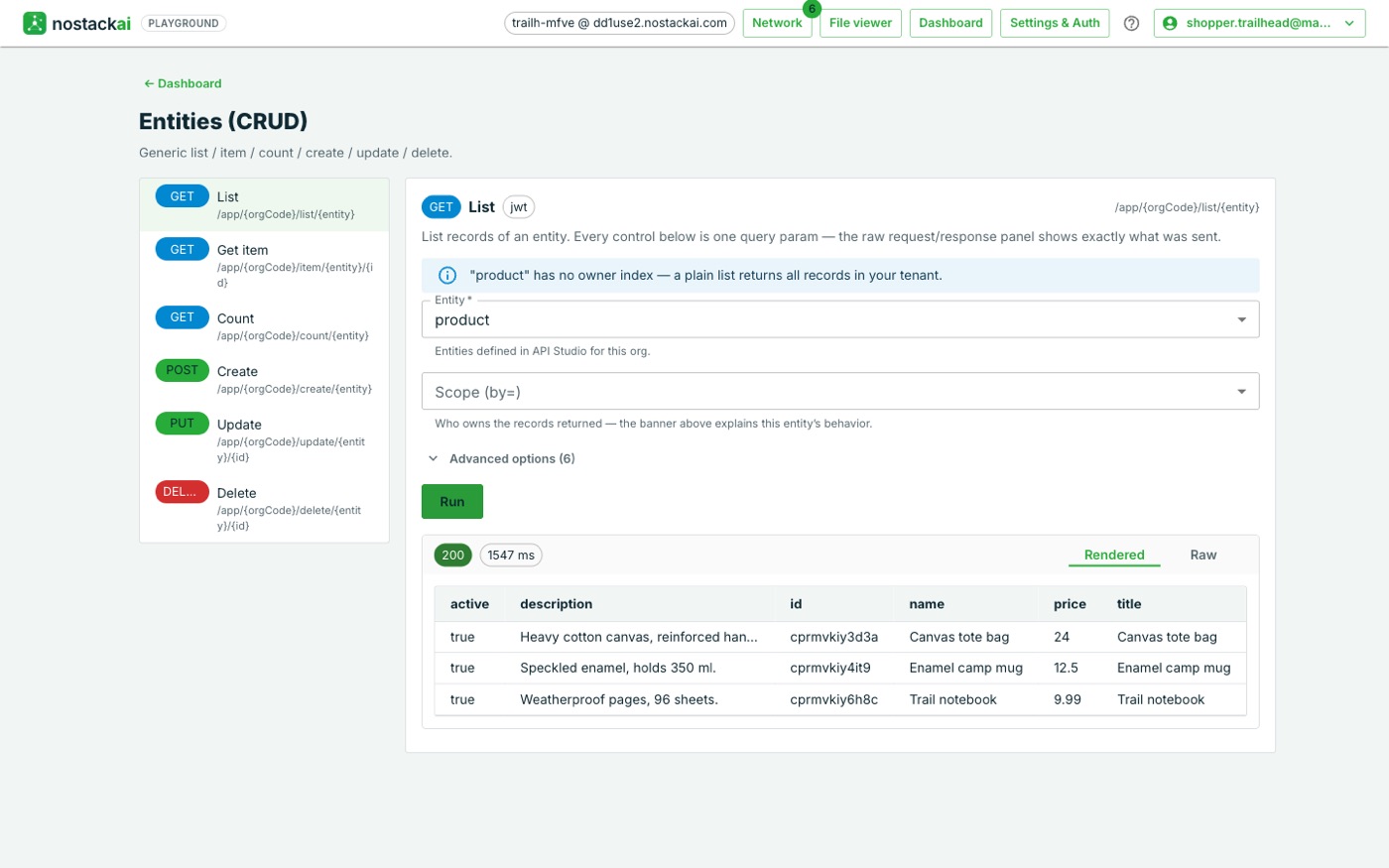
get_platform_capabilities and a live API reference, so the AI does not guess at what existstest_logicblock and invoke_glyph, then publish to production yourselfEach entity gets create, get, list, update, delete and count endpoints, with search, filters, facets and pagination. A live OpenAPI 3.1 spec stays in step with every change.
Attach events to any entity. When a record is created or updated, nostackai runs what you chose, in the background or as a gate before the write is saved.
Logic Blocks are deterministic pipelines. Add an AI step, a crew or a human approval exactly where you need one. Each AI step gets only the fields you map, answers in the shape you ask for, and runs under the token caps you set.
Classify, extract, summarize, decide, translate, moderate and more. Pick the model per step and ask for a score, a category, a yes/no or JSON, so the answer stays small and checkable.
Pull text from documents, images and audio, and transcribe speech, inside the same Logic Block.
Agents run as a graph. Agents without unmet dependencies run in parallel, each with its own model and memory.
A crew pauses for a person to approve, answer or edit, from the console or your own app.
Read and write entities, call connectors, run Glyphs, search the web, or hand off to another crew. Access policy applies to every call.
A token cap per step and per crew run, turn limits, and guardrails that stop off-topic input before the model is called. Tokens and cost show per run and per workspace.
# glyph: apply_loyalty_discount   (Python 3.12)
def handler(request, ctx):
    order = ctx.app_db.get_entity('order', request['id'])
    past = ctx.app_db.list_entities('order',
        filters=[{'field': 'customer', 'op': 'eq',
                  'value': order['customer']}])
    rate = 0.1 if len(past['items']) >= 5 else 0
return {'discount': round(order['total'] * rate, 2)}A Glyph is a small function in Python 3.12 or Node 22 that runs sandboxed next to your data. Use it as a Logic Block step, an agent tool, a scheduled job or its own endpoint.
ctx.app_db, ctx.http, ctx.connector, ctx.ses, queues and events, plus a curated standard libraryAdopt a connector for your org, and each customer workspace enters its own keys. Call it from a Logic Block, an event, a schedule, an agent or one API call. Inbound webhooks land straight in your entities.
Checkout for one-time and subscription products, cancellations, and signed webhooks that confirm payment back into your entities.
Notify from any automation, Logic Block, schedule or agent.
Create, update and upsert any Salesforce object.
Hand a task to a coding agent from a crew or a Logic Block.
Issues, pull requests and page captures as workflow steps.
Web search results your agents can reason over.
Shipping labels and rates, sales tax, address lookup.
Call AWS services and write to your own buckets.
Bookings and events in your data.
Reach 7,000+ apps through Zapier.
Connect anything not listed: any HTTPS endpoint with no auth, a bearer token, basic auth, a custom header or OAuth2 client credentials, and the payload you map.
Everything a B2B app needs once the first customer signs, without writing it twice.
Single, hybrid or multi-tenant apps. Users join or create workspaces, accept invites, and get workspace admins.
Each customer workspace signs its users in with Okta, Google or a password. Domain checks keep the wrong company out.
General values and encrypted secrets per workspace, email templates and branding, read by your logic at run time.
Run a Logic Block, Glyph, connector or crew once, on an interval, or on a cron, in any timezone.
Targeting rules, percentage rollouts, scheduled changes and per-workspace overrides, with JavaScript, React, Vue and Angular clients.
Stripe, Paddle, Dodo Payments and PayPal for one-time and subscription checkout, confirmed by signed webhooks.
Every app gets a secure wss:// endpoint. Stream AI answers token by token, show a crew working step by step, or push one update to everyone watching, with no socket server to run.
notifyall in a Logic Block to push its result to everyone on the channelconst ws = new WebSocket(`wss://<your app's realtime endpoint>?token=${token}`);
ws.onopen = () => ws.send(JSON.stringify({
action: 'customapi_run', // run a Logic Block, stream it
channel: 'order-board', // you name it; scoped to your workspace
message: { apiName: 'mark_shipped', input: { id: '4821' } },
}));
ws.onmessage = (e) => {
const { type, data } = JSON.parse(e.data);
// customapi_result → your own result
// customapi_message → pushed to everyone on the channel (notifyall)
// turn_event → each step of a crew run
};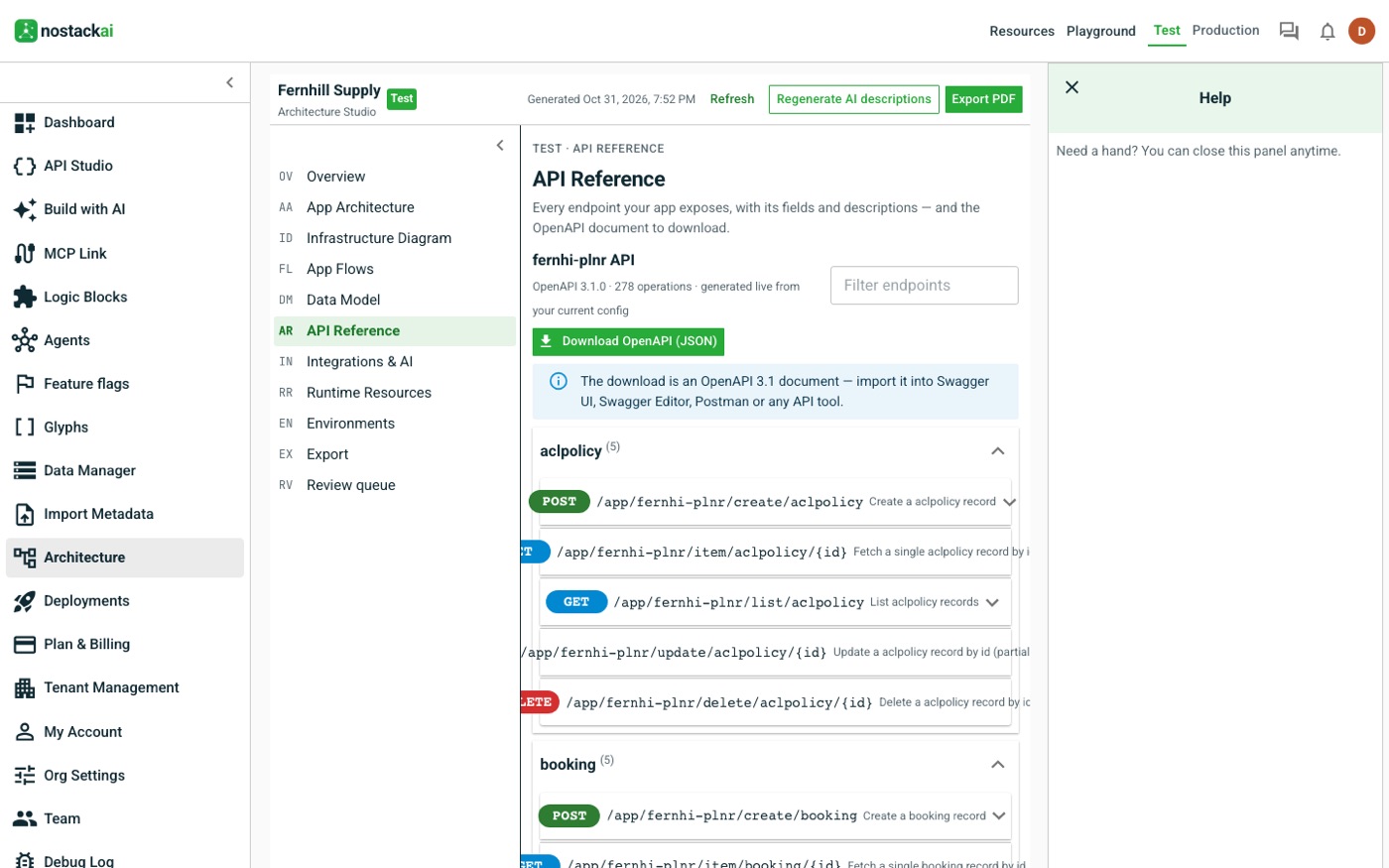
Documentation is generated from your configuration every time you open it. Change an entity or a Logic Block and the docs already show it.
The tools you need once real customers depend on the app.
Publish from dev, compare versions by content, activate and roll back.
Call log, error rate, p50 and p95 latency, agent cost and guardrail hits, with traced and redacted delivery history.
API calls, records written, Logic Block runs, and AI input tokens, output tokens and cost for each customer workspace.
Every org's and workspace's data sits in its own partitions, checked on the server for every request. Enterprise gets a dedicated stack.
Supabase is a great database. AI app builders are great at UI. nostackai is the backend your AI builds once and does not have to keep rebuilding.
| Capability | nostackai | Supabase | Xano | AI app builders Emergent, Lovable, Bolt | Workflow tools n8n, Zapier |
|---|---|---|---|---|---|
| Who writes the backend | ✓Your AI, as config, over MCP | !You: SQL, edge functions | !You: visual or XanoScript | ✓The builder's AI, as code | !You: visual flows |
| What a change costs | ✓A small config merge | !Your time | !Your time | ✕A new prompt over the codebase, billed in credits | !Your time |
| AI tokens in each production request | ✓None, unless you add an AI step | ✓None | ✓None | !Depends on the generated code | !Per AI node |
| AI keys and billing | ✓Your keys on every plan, per workspace, no markup | !Bring your own | !Bring your own | ✕Platform credits | ✓Bring your own |
| MCP server for your AI client | ✓90 design-time tools | ✓Official server | ✓Developer MCP | ✕Built-in agent instead | !MCP nodes |
| Multi-tenant SaaS: workspaces, workspace SSO, per-workspace settings | ✓Built in | !Build it with RLS | !Build it | !Whatever was generated | ✕ |
Connect your AI client, build your backend, ship to production.